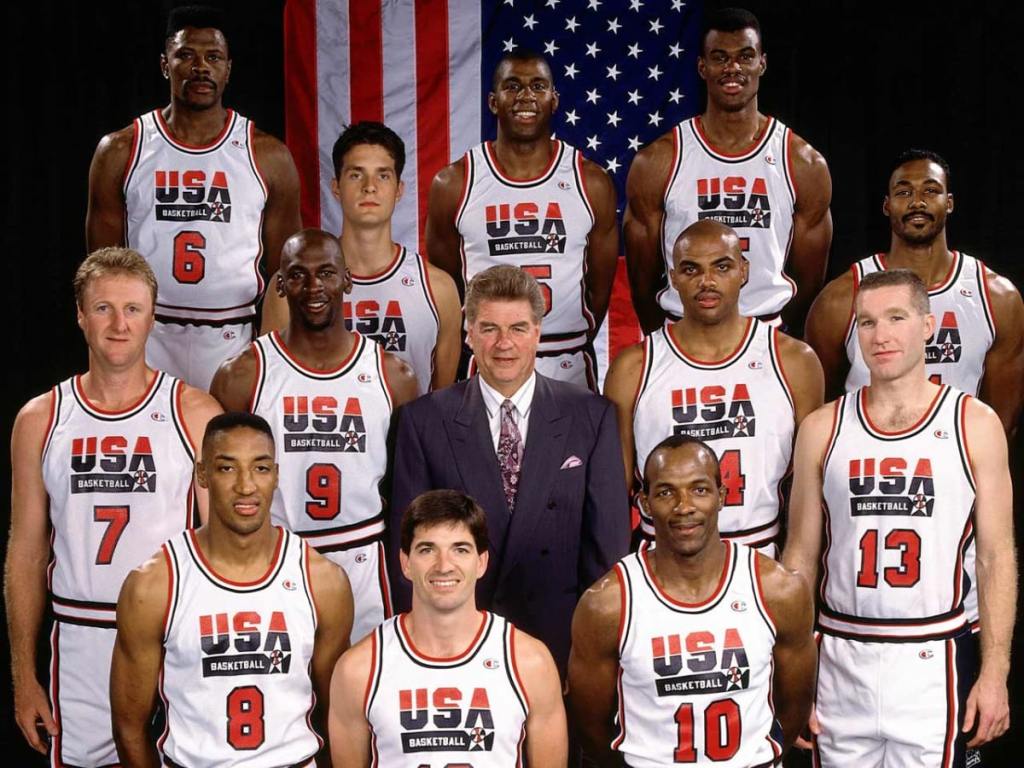
This week, I attended the Humanex Impact & Legacy Summit in Omaha, NE. The first keynote speaker was Don Yeager, the former editor of Sports Illustrated, and now a speaker on sports, business, and leadership. He wrote Great Teams: 16 Things High Performing Organizations Do Differently, exploring the shared themes of what make the great teams great.
In his keynote address, he talked about his obsession with USA Basketball. In 1986, the Olympic Committee voted to allow professional athletes to compete in the Games, which opened the door to the 1992 Men’s Basketball team – the Dream Team. USA Basketball dominated in the 1992 Olympics in Barcelona, but began to experience atrophy as the rest of the world caught up, reaching rock bottom in 2002 when USA Basketball placed 6th at the FIBA World Championship. In search of answers, USA Basketball changed its approach, bringing in a Coach Mike Krzyzewski (Coach K) from Duke University to coach USA Basketball. USA Basketball identified Coach K as the right leader for this team for three reasons:
- He was an assistant coach on the 1992 Dream Team, so he was familiar with coaching great professional athletes.
- At the time, he had won 5 NCAA Division 1 Men’s Basketball championships, making him the most successful coach in NCAA Division 1 Men’s Basketball since John Wooden’s dominance at UCLA.
- He played basketball at the US Military Academy at West Point and began his coaching career with cadets at West Point.
These characteristics gave Coach K a tremendous advantage as he began the process of rebuilding USA Basketball. As he began to understand the makeup of Team USA, he identified that the current and past players fell into one of two camps. He called the first group of players “the Patriots.” These players wanted to represent the US in international competition and were all in on playing for Team USA. The second group of players were “the Mercenaries.” These players were committed for the glory. They were there because of sponsorships and their own pursuit of their legacy.
Over the next years, Coach K worked to change the culture of USA Basketball by seeking out Patriots, instilling a greater sense of national purpose, and creating “feel-it moments,” where the players could interact with those who serve as first responders and military personnel. And as Coach K shifted the culture of USA Basketball, it rose again to dominance on the international stage.
This story got me thinking about greatness and legacy. Don’t get me wrong – I’m a huge sports fan. I love sports stories, I nerd out about stats, and I’m a sucker for the narratives about athletes who demonstrate greatness. But I think we’re missing the point. We idolize the athletes who dominate, the CEOs who lead successful companies, and the people who pursue greatness as spiritual leaders, community servants, educators, and servicemen and women.
But who are those truly exemplify lasting greatness? I’m drawn to the uncomfortable answers to this question found in the story of Alexander Hamilton. One of the great statesmen of the United States, brought back to pop culture through the tremendous storytelling of Lin Manuel Miranda. At a glance, Hamilton and Miranda are great. At the end of the musical, Miranda (as Hamilton) sings, “Legacy? What is a legacy? It’s planting seeds in a garden you never get to see.”
In this question, there is no prescription for greatness that can be found in a vocation or a profession, but a charge to plant seeds and trust. A gardener plants seeds for the future, trusting that these seeds will grow and flourish into a place of beauty.
As a culture, we are consumed by greatness, but I think we miss the mark. Our aim ought not be the pursuit of our own greatness and legacy, but the pursuit of excellence. Excellence does not discriminate by vocation. We can be excellent as an employee, an artist, a leader, a parent, or a sibling. We can be excellent in any profession and in any context, pursuing the work set before us with an eye towards excellence, not greatness. We choose excellence in the small things each day, choosing kindness, inclusion, and integrity. These habits build excellence in our contexts.
I don’t diminish those who desire to be great and do it in ways that receive recognition and praise. But my perspective of greatness is shifting – and I’m learning that I don’t want to be great. I want to be excellent at the work that the Lord has set before me, pushing onward in the work He has placed before me as I progress towards His glory and His good.
Fin.
 A Profitable Read